Line Follower
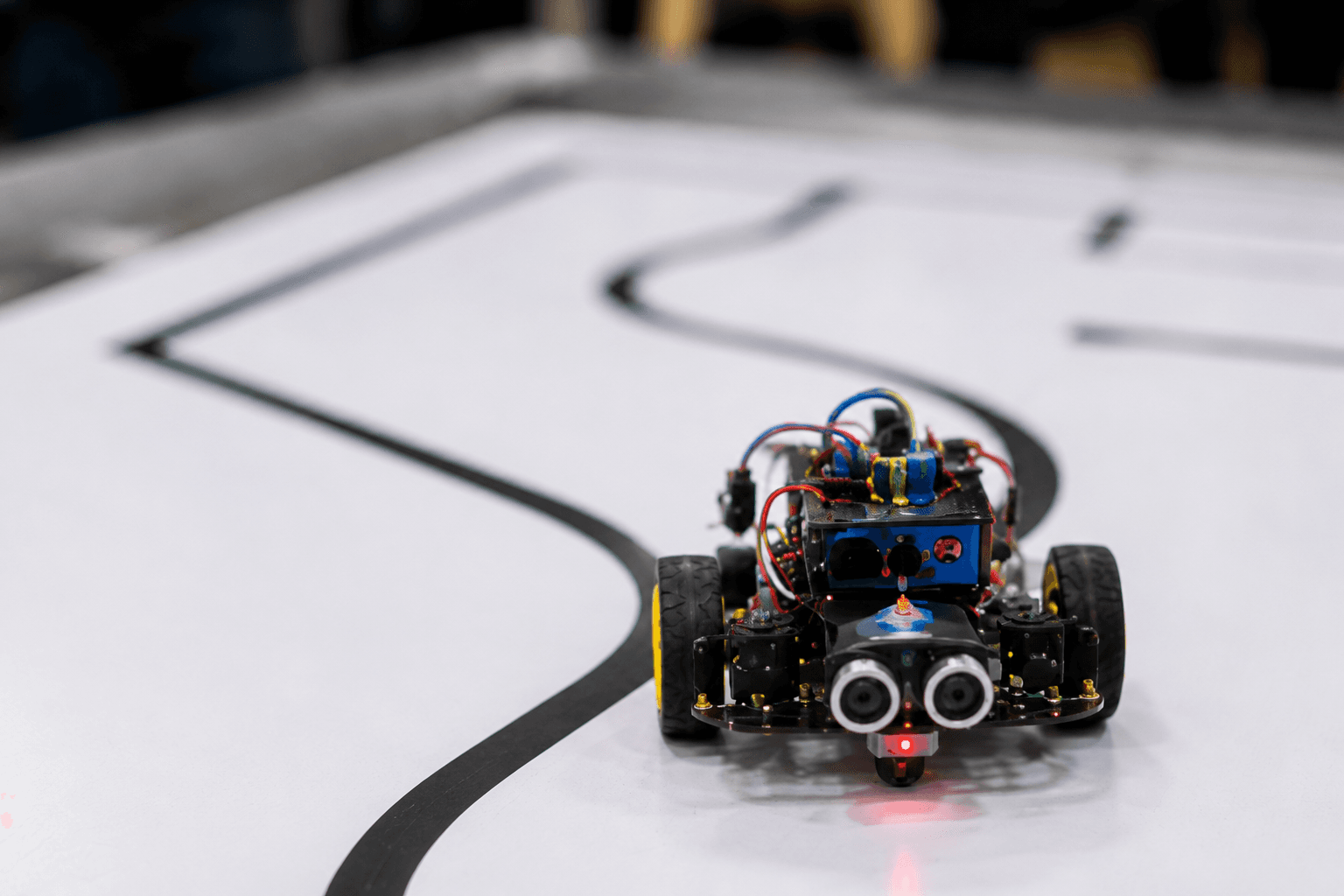
Build an autonomous robot that follows a black line on a white surface and completes the track in the shortest time.
Overview
The Fastest Line Follower Robot Challenge is a robotics competition where teams design and build an autonomous mobile robot capable of following a predefined black line on a white surface and completing the track in the shortest possible time. The robot must start behind the starting line, autonomously follow the black line throughout the course, and complete a full lap of the competition track. A robot is considered to have successfully finished the course when any part of the robot crosses the finish line after completing the full track. The competition takes place on a specially prepared arena, referred to as the Competition Field.
Rules
- •All robots must be wireless and autonomous. No wireless communication between robot and operator (Bluetooth, RF, etc.) is allowed.
- •Robots must be able to move in all directions (omnidirectional movement).
- •Robots must operate entirely autonomously; manual, remote, or app control is not permitted. Detection of manual or wireless control leads to immediate disqualification.
- •Robot must complete a full lap; maximum 3 restarts per round, from starting point. Best (minimum) time counts.
Requirements
- •Autonomous line-following robot; wireless, within size/weight for category
- •Max 12.8V DC; sealed batteries (gel, lithium, NiMH, NiCad, or dry cells)
- •Clearly visible team name or team ID on top of robot
- •Designed and programmed by the team; no fully pre-assembled commercial robots
Eligibility Criteria
- •Junior Category (Jr.): Open to schools, robotics clubs, or individual participants. Participant age must be between 6 to 10 years. Designed to introduce young students to basic robotics and sensor-based control.
- •Senior Category (Sr.): Open to schools, robotics clubs, or individual participants. Participant age must be between 11 to 16 years. Focused on intermediate robotics concepts and faster robot control.
- •Open Category: Open to colleges, universities, and independent teams. No age restriction. Intended for advanced designs and competitive performance.
- •Age verification may be conducted during registration or reporting.
General Rules
- •All robots must be wireless and autonomous.
- •No wireless communication between the robot and operator is allowed (Bluetooth, RF modules, etc.).
- •Robots must be able to move in all directions (omnidirectional movement).
Robot Dimensions and Weight
- •Junior Lego Division (Jr.): Must fit within 20 cm × 20 cm × 20 cm (L × W × H) at any time. Maximum weight 3 kg including batteries (5% tolerance). Can be circular or rectangular.
- •Senior Division (Sr.): Must fit within 20 cm × 20 cm × 20 cm at any time. Maximum weight 5 kg including batteries (5% tolerance). Can be circular or rectangular.
- •Open Category: Must fit within 20 cm × 20 cm × 20 cm at any time. Maximum weight 1 kg including batteries (5% tolerance). Can be circular or rectangular.
Safety and Electronics
- •Batteries must be sealed and of a safe, immobilised electrolyte type (gel cell, lithium, NiMH, NiCad, or dry cells).
- •Maximum voltage on the robot cannot exceed 12.8V DC at any point.
- •Robots cannot use infrared-reflecting materials on the outside. Any paint should have a matte finish. Minor reflective parts are allowed if they don't affect other robots.
- •Robots cannot produce magnetic interference for other robots on the field.
Control System
- •Robots must operate entirely autonomously.
- •Manual control, remote control, or mobile app control is not permitted.
- •Detection of manual or wireless control during gameplay will lead to immediate disqualification.
Robot Identification
- •Each robot must have a clearly visible identification marker on top.
- •The marker should display the team name or team ID.
- •Robots without proper identification may be disqualified.
Originality and Design
- •The robot must be primarily designed, assembled, and programmed by the team.
- •Fully pre-assembled commercial robots are not allowed.
- •Standard components such as motors, sensors, and controllers are permitted.
- •Original design and innovation are strongly encouraged.
Junior Category (Optional Restriction)
- •Organizers may restrict construction materials to LEGO or LEGO-compatible kits to ensure safety and accessibility.
Start, Calibration, and Restart Rules
- •Start: Robot must be placed behind the starting line. The run begins only after referee approval. The robot must start within 30 seconds of the start command.
- •Calibration: Teams are allowed calibration time to adjust sensors and parameters. Calibration time is not included in gameplay time.
- •Restart required if: the robot fails to follow the line, stops moving, exits the arena, or is touched without referee permission.
- •Restart rules: Maximum of 3 restarts per round. The robot must restart from the starting point. Reprogramming is not allowed during the run. Sensor adjustment is allowed with referee consent. The run timer resets on restart, but overall competition time continues.
Competition Format
- •Elimination Round: Calibration time 1 minute, gameplay time 3 minutes, maximum 3 trials, maximum 3 touches allowed across all trials. Best (minimum) time is considered. Top 30 teams qualify for the final round.
- •Final Round: Calibration time 1 minute, gameplay time 5 minutes, maximum 3 trials, maximum 3 touches allowed. Best time determines the winner.
Scoring and Tie Breaking
- •Primary scoring criterion is minimum completion time.
- •In case of a tie: fewer restarts, then fewer human touches, then final decision by the referee.
Disqualification
- •A team may be disqualified for: manual or wireless control; unsafe robot construction; violation of size, weight, or voltage limits; damaging the arena intentionally; misconduct or unsportsmanlike behavior.
Organizer's Decision
- •The organizing committee and referees reserve the right to modify rules if required.
- •All decisions made by the organizers are final and binding.